The Next Inevitable Eruption

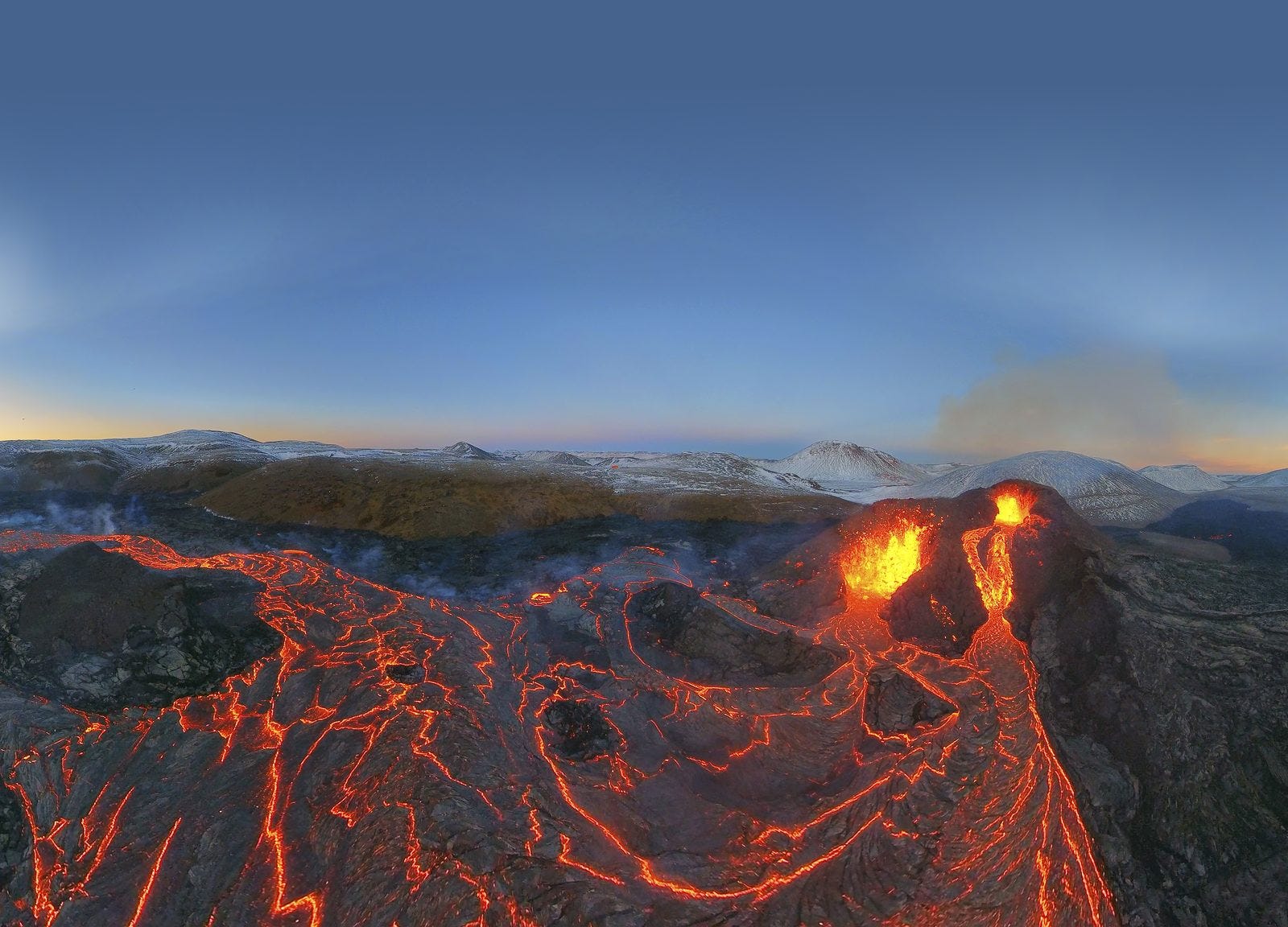
The Fagradalsfjall volcano in Iceland erupts approximately once every four years. It’s an extremely active volcano, and it’s a beacon for international tourists. Luckily, Fagradalsfjall hasn’t erupted catastrophically since the 18th century. The eruptions are not deadly but they are constant, and there is always the chance that the next eruption could be deadly. Every time the volcano bubbles, it could be the beginning of a tragedy Icelandic people are waiting for.
That’s what I can’t stop thinking about— the waiting.
I find the hyper-vigilance needed to live somewhere like this exhausting. In a video I find on YouTube, a restaurant owner says that as a kid she remembers waking up every day afraid. Body tense. Anticipating the lava, the ash, the black soot sure to cover their lives at some point. For a moment in the video she seems scared; then she blinks: ‘you get used to it.’
Lately I am consumed with worry. Existential dread, my longtime friend, has become so very present day to day. I worry about aging, I worry about time passing too quickly, I worry about someone in my life getting sick, I worry constantly about who will be the next to die. In what way. I try to breathe through the fears but sometimes even my comforts scare me. I stick my face in my cat’s fur to try and recenter myself and then I remember he’s 11 and could die at any time.
I remember as a girl thinking about my grandparents dying, my brother, my parents, my friends, and being absolutely inconsolable. It wasn’t the fact of death, really, but the way it could come at any moment. The surprise of it. It felt then and feels now absolutely unfair (see this essay I wrote and published regarding my inability to accept my cat’s death when I was young). I’ve been obsessively preparing for devastating death to strike my entire life.
And then the devastating death did strike. Like an eruption of hot lava this new life experience of heavy grief hammered itself into my life. My friend Mary, 32 years old, died in her sleep in July 2024. She had an unnoticed stomach ulcer that burst, sending her into sepsis and eventually killing her. The death, tragic enough on its own, was compounded by my learning of it. She died on July 8 and I didn’t know she was dead until August 5.
I know what you’re thinking: it’s impossible for a close friend to die and you not know for almost a month. I actually wrote a short story about this experience and my workshop colleagues all gave me the same note: it is unbelievable that the main character wouldn’t know of her friend’s passing for that long.
Mary lived in Alabama, alone; I live in California. We spoke almost daily in our group chat with our friend Sam, and we Facetimed at least monthly. When she stopped answering our texts, when she missed a schedule Facetime, Sam and I knew something was wrong. We called and texted her independently, checking in. For the first week and a half it was easy to assume that she was just caught up in her demanding job, or that she was back home for a family emergency. The second week I drafted a message to her younger sister, something like hey, I really don’t want to worry you, but have you heard from Mary? But I didn’t send the message. I didn’t want to worry the twenty-one year old, and I also wanted to protect Mary in case something was wrong and she didn’t want her family knowing. During the third week Sam and I volleyed reasons why Mary wasn’t answering back and forth: she’s mad at us for something (lol, she would have never engaged in that kind of cruelty), she’s having a tough bout of depression, she’s just backlogged with texts. Had either of us googled Mary’s name we would’ve seen her obituary.
That haunts me.
We found out once Mary’s father was able to get into her iPhone. He saw all of our missed calls, texts; when he called Sam with the news he was devastated anew. He’d been notifying so many people, family, friends from childhood, friends from college. He felt awful that we hadn’t been told, but we’re her adult friends, and if it were me who died, I don’t think my parents would know to contact Mary and Sam. I hold only love for her family and for the outstanding pain this grief has been. And my grief is all kinds of fucked up and compounded because of the delayed knowing. From finding out in the middle of an important day at my job, having to run to the bathroom to puke and scream before returning for the next inane four hours of work.
Shocking to no one, my life’s work in preparing me for this tragedy did nothing to help me when it came. The grief was and is astounding. Next month it’ll be her death date. The first anniversary. The year has felt like a month and also like ten years. I don’t have it in me right now to examine, for the seven hundredth time, my text thread with Mary, the date of the last words exchanged. It was sometime around now, last year. We talked about the stuffed shells she was making, the basil she needed.
About once a month I get hit with the grief and cry a behemoth cry. The grief is so different from my daily existential dread. When I’m in dread mode I am so active, so alert— I am running, looking back over my shoulder. When I’m in grief mode I’m not active at all. I sink. When it comes time to surface from the grief, though, I do feel emptied, like a valve has just been opened and something has been released. No such valve exists in the dread. And it occurs to me that what I’m trying to outrun with the dread is the grief. The wave that consumes me is what I’m desperate to outrun.
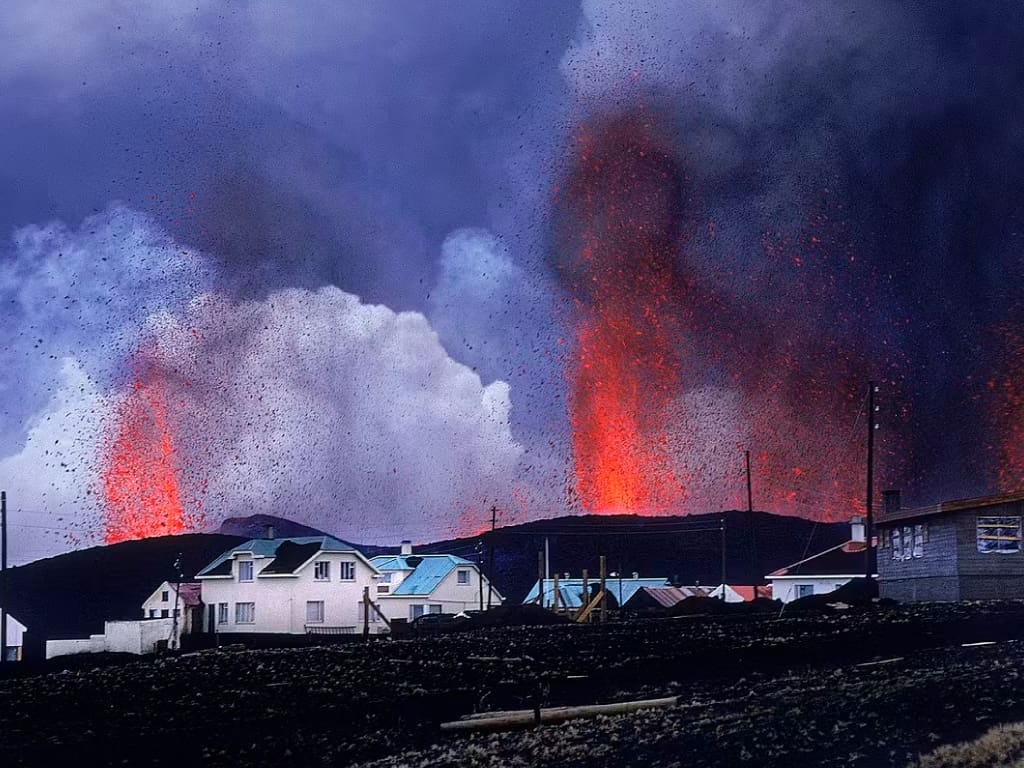
In 1973, two monstrous fissures opened from the ground on Heimaey island in Iceland. The town’s 5,000 inhabitants fled on boats from their homes, some of them with barely anything. None of them knew when they would be able to return, or if they ever would. There’s a museum now on Heimaey island— one of the ruined homes stands as it was after the eruption for visitors to walk through. Black soot covering the floor of the rooms, broken memorabilia scattered, family photos covered in a film of ash. These things that constitute a life.
I’m struck by the difference between Icelandic locals’ experience of living with the threat of a volcanic explosion and the tourist’s experience. Tourists purposefully come to Iceland to see this terrifying power, the threat of tragedy. I actually laughed out loud hearing a wedding officiant complain about the heat at the elopement spot couples flock to: ‘I could feel my ass cheeks melting off.’
These tourists get to witness this circular discharge of tragedy, but they don’t live with the threat of it. Before Mary died, I was a tourist to grief. I was walking around on molten lava, trying to stick my toe into still-red embers. My existential dread wanted to hang my body off the cliff of grief because I thought it would be helpful. I thought I could prepare.
There’s eons of life between existential dread and really experiencing tragedy. I spend so much time in my writing life stuck in the past, in 1966 when my father was six years old and his life was upended. His house, blown up and obliterated with dynamite; the dynamite placed intentionally by his father. As a child my father knew these things. He didn’t have to prepare himself for the big tragedy because it came so devastatingly early. I see something new in my understanding of my father when I think of him as that six-year-old boy. How lonely he must have been, for years, with this intimate awareness of violence, of tragedy.
I fear that Mary’s death in some ways validated my existential dread. Like, see, we were right all along! Tragedy WILL befall you! It WILL be extremely hard, life-changing, mind-altering. And people will keep dying. I mean, it’s true that every day gets us closer to our own deaths and to others. It’s true that my parents are aging states away. That my best friend could die before I get another hang with her. My husband might get in a car crash on his way home from work today and stop breathing. Our last words to each other would be something about needing a new dining room rug.
It scares me to think that summer now will be my grief season. That the heat will always take me back to last summer, that August I drove myself to the beach more than I ever have because it felt better to cry in the ocean. Salty cheeks, impossible pain.
Heimaey island still exists, although its roads and infrastructure are completely changed. The landscape around Fagradalsfjall is drastically different than it used to be, changed forever by the shocking power of the constant eruptions. Entire valleys have been filled, over time, with molten lava.
My existential dread needs to accept the new tributaries of grief in my body. This anticipatory grief, it doesn’t serve me anymore, if it ever did. Maybe, the next time I find myself trying to outrun my dread, I can reroute myself. Maybe I can walk right into the wave that’s cresting behind me, just sit the fuck down, get into fetal position, and let the grief pull me under.
And when I surface, emptied, gutted, I’ll make a good meal, I’ll feel the grass under my bare feet, I’ll slowly kiss my husband’s lips. I’ll say hi to Mary, tell her I miss her.
Recently I read Yiyun Li’s new memoir Things In Nature Merely Grow. Li is one of my favorite writers, and I loved the surrender she came to in this new book. A kind of surrender born from experiencing unrelenting tragedy. Things live, things die.
We don’t get mad at a volcano for erupting, it’s just… what it does. It’s nature. Maybe grief is too.
that valve that empties, the cliff, the tourism of grief, you put to words all the ways it feels to experience loss at the cruel hands of tragedy - we will forever be changed like those volcanic towns and what we have after is this, it’s understanding and a lifetime of reckoning and turning it over and over again. we find ways to sink into it and come back up again. love you
god what a beautiful conclusion. yes. some things i'm afraid of, like flying in an airplane, will probably never actually end in my worst case scenario, but that fear many (all?) of us have of our loved ones dying WILL happen, and we have to live with that. I mean, woof. It reminds me of the convos we've been having about our work: one page at a time, because to imagine all the work ahead still is too overwhelming. To imagine all the suffering ahead is just unbearable. But to be in the present moment, that's usually pretty okay. And there's joy ahead, too, a lot of it. Love you & sending you comfort as you ride the grief wave <3