Now What

On June 15, I finished writing my book. I’m not trying to be mysterious by not disclosing the title but I do feel somewhat superstitious revealing it here (lol)— LMK individually if you want the title and I’ll tell you!
This is the second full draft of a book I’ve completed, having reworked my first draft into this version all of this year. I’d developed a relatively healthy writing practice throughout the year (thanks in large part to The Fountain), and I’ve felt good about my writing pace, writing habits, etc. In mid-June I did a word count tally, something I typically avoid doing because it makes me too anxious. I realized I was 3/4 done with the thing. I had three or four more chapters to go; perfect, I thought— my established pace and writing practice would get me across the finish line somewhere near the end of summer. But then an opportunity fell from the sky, a hot dying star, and I had to finish the last fourth of the book at hyper-speed.
I wrote the last fourth in one weekend. It’s not something I recommend!!!! I quite literally felt my self decaying as I did so. I’d wake up and wear the clothes I slept in all day; I was disinterested in feeding myself. I of course developed a cold sore (which actually felt cosmic, as lindsey peters berg reminded me that I suffered a cold sore when first reading through the archival documents used in my book), broke out all over my chin, forgot to brush my teeth.
On that Sunday when I finished, my husband made me a cheeseburger and baked me macaroni and cheese, a hearty meal because he knew I’d hardly been eating. I ate it and then sat on my back, legs up against the wall. I did a breathing exercise, tried not to mess with the blister on my top lip. I had just reread the entire draft, all 14 chapters, and I felt surprised by how much I liked what I’d written. I knew what came next was the final chapter, and my fingers felt staticky, electricity somewhere deep inside of my chest; it was similar to how I felt before volleyball games in high school, Dashboard Confessional blaring through my CD player in some dingy high school locker room. Like, let’s fucking do this. I got up off the floor and did it. I wrote my final chapter.
I can’t adequately describe the experience without using spiritual language. I didn’t feel like I was writing so much as translating— I was a lightning rod, receiving and then transmitting words from elsewhere. From above or below or far in the past or deep in the future. The Fountain calls this feeling, when you’re really in sync with your writing, channeling. I’ve begun to think of it as communing. I didn’t know what my fingers were typing until it was all there, the final image the only one it could have ever been. I'd never felt this kind of deep, powerful knowing before when writing, and it bowled me over. This thing I’ve been working on for so long, now complete. Circles closed. I knew, in that moment, that I’d communed with my father, my grandfather, and some all-knowing chorus in telling this story. I knew I’d gotten it right this time.


I tend to expect and want celebration when something good happens. It’s the Aries Sun in me, wanting to be in the spotlight, wanting to be seen as a winner. That part of me isn’t always pleasant, isn’t always someone I admire. But something weird happened in the aftermath of finishing my book— I’d accomplished my loftiest goal, I’d birthed the project of my life, and yet I felt no real need to be celebrated. I didn’t want a dinner party with friends or a night out. Instead I got myself gelato midday on a Wednesday, lemon and raspberry sorbet that tasted especially delicious in the eighty degree LA heat. I texted paragraphs of relief and disbelief and pride to lindsey peters berg , her voice notes and congratulations all feeling like confetti raining down on me. I met with my dear friend Meg Flores to see Melissa Febos read from her new memoir The Dry Season and Meg bought me chocolate chip cheesecake at House of Pies (the only celebration one really needs is sitting across from writers and friends you admire who believe in you and your book).
I told Melissa as she signed my book that I’d finished my own memoir, my first, mere days ago. I thought: this is its own celebration— talking with one of my favorite writers, calling myself a memoirist.


My husband and I had a weekend trip planned to attend a wedding in Orange County. We stayed in a boutique hotel on the Pacific Coast Highway thanks to credit card points (lol); the place was gorgeous, a Spanish-style villa decorated immaculately. We had the cottage to ourselves, a suite-like room overlooking the gorgeous pool and shimmering Pacific. For hours we had the pool to ourselves; we passed a pair of goggles back and forth, I showed him how to do the washing machine (crucial scene in my book at the pool as a teen, iykyk), he rated my handstand (a 9). We had so much fun.
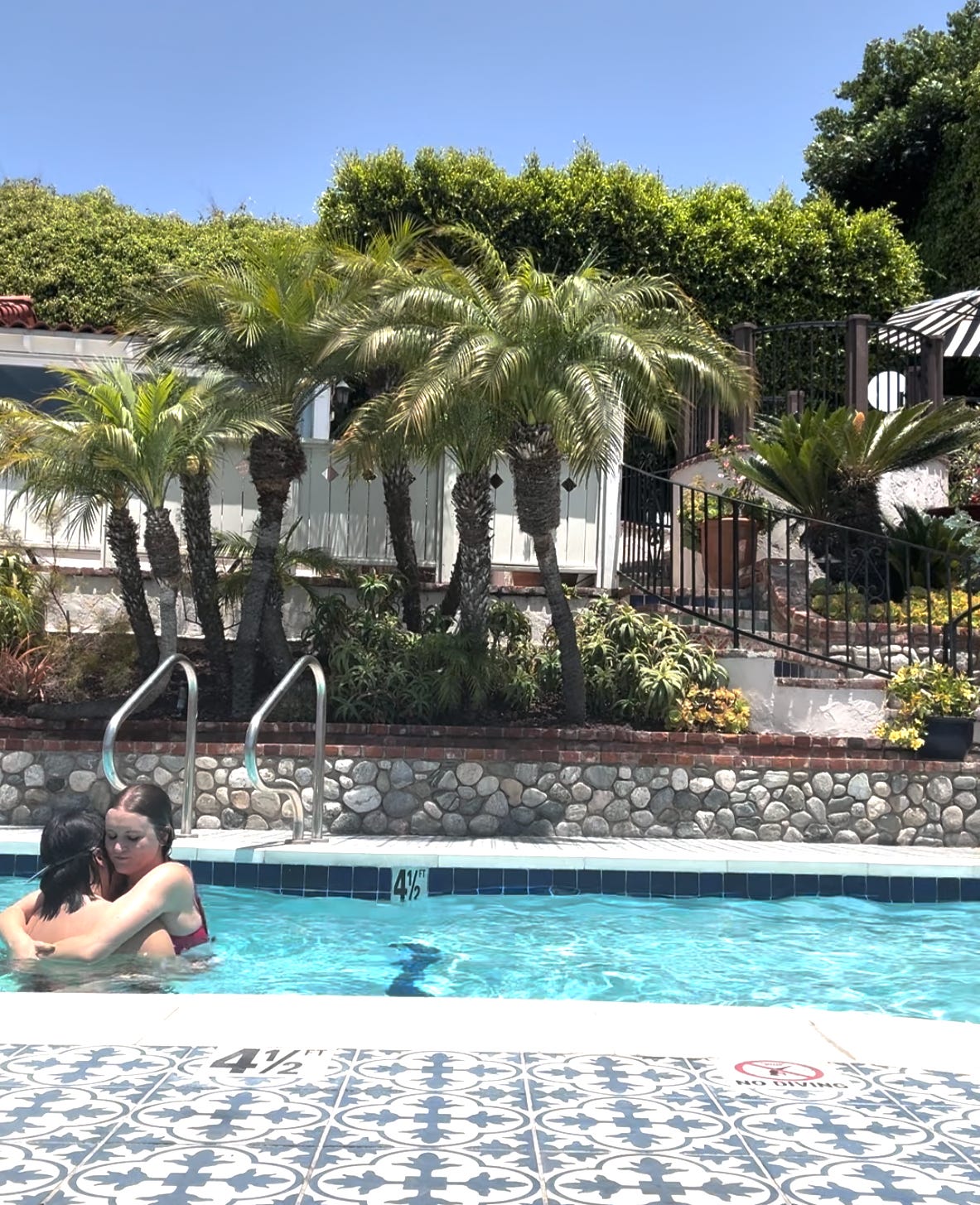
And I really didn’t think ‘wow I finished my book’ that often; my body was somehow ready to receive feelings outside of pride, ready to be wowed by how much I love my husband, awed by good food, contented by the sunshine. I did swim underwater from one pool edge to another at one point and when I got to the end of the pool I jumped up and resurfaced, thinking I FUCKING DID IT!!!! It reminded me of the weekend after I found out I’d won the Cincinnati Review’s Robert and Adele Schiff award for Best Essay in November of 2024. We were staying in Santa Barbara to see Kacey Musgraves, and in the shower after the show I wrote with my finger on the steamy glass door I’m a writer and jumped up and down.
But the real celebration for finishing my book was in those solitary moments after writing the final words, that private euphoria, the experience of which exists lightyears away from my describing it.
I had an interesting experience while writing my memoir in the chapters depicting an abusive relationship I was in for years— this feeling of wanting to be done with telling that story came over me. I think it’s partially due to shame, how even years after an experience what happened can stay on you like a second skin. Dark circles of shame like sunspots on my psyche. Writing nonfiction, for me, is often a reckoning with shame, an attempt to fully see and accept the self that made the decisions she did at the time. I try, when writing about that relationship or about other interpersonal happenings, to make the focus less on the person who perpetrated the thing and more about who I was on the receiving end. I stayed in an abusive relationship for a long time, despite my body sending me every sign to leave. Yes, my partner at the time wronged me, did terrible things— but is that interesting to write about or to read? Is it the full story? I’ve written about that relationship before, but in the chapters of my memoir I think I finally wrote about it in a way that felt true and liberating, because the gaze of the work was squarely on me.
Often I think about the person in my undergraduate workshop who said ‘I wish something like that happened to me so I had something to write about’ after I first workshopped a piece about my family history. (Like, bro, you wish your grandfather attempted to murder your father????? LOL but people do think like this!) I’m hyper-vigilant to not cross some self-imposed line of farming my life for trauma to make into content. I’m wary of leaving that sentence hang, fighting the impulse to say ‘I haven’t always been great at that!’
There were things that happened to me that I intentionally left out of my memoir, three instances especially that I decided to leave out, mostly because of how much space they each demanded. They do exist in another nonfiction project, currently on pause, the title of which is The Victim Narratives. The first event: I was harassed online by an anonymous man; over a two-week period the harassment turned to stalking, messages populating my inbox constantly, sexual and predatory in nature. Then, a few months later, I was roofied by someone I had known since childhood on a rare night out in my hometown. And finally, at the close of that year, the man I was dating had sex me without my consent when he was blackout drunk.
I even feel hesitancy now calling these things what they were: stalking, rape. Notice how I padded the delivery of the fact in my paragraph above.
It fucked me up to experience all three of these things back to back— I remember thinking if I had experienced one of those things in a silo I’d maybe be able to chalk it up to unfortunate fate. I may be able to fully believe I was a victim. But something about all three happening, it felt like a punishment, something I got myself into.
It’s actually empowering to choose not to include those in my book, to know that my story can be told without that bit. And I love the empowerment that comes from the title, The Victim Narratives, because it actively disrupts the age-old idea (one I still experience regularly) that talking about what’s happened to you is ‘playing the victim.’ If I can remind myself of the ridiculousness of these three things happening in the same year, I can more gently and more quickly come to the conclusion that is the truth: those things happened to me for no reason. I was not to blame. I don’t know if I’ll return to that project or if, for now, what I have to say about that year has been said. I’m OK with either conclusion.
At Melissa Febos’s reading she talked about a prism, how she looks at others, especially those who have hurt her, through a distorted mirror where she sees herself. It reminded me of one of my favorite Kendrick Lamar lyrics from GNX: every individual is only a version of you.
Melissa talks a lot about her ex in The Dry Season; she calls her The Maelstrom. In The Möbius Book, another recently published title, Catherine Lacey calls her ex The Reason. Both writers, and both projects, are interested in learning, with grace and radical acceptance, about the selves that accepted these relationships. The passages below from The Dry Season especially struck me:
When the Maelstrom struck and especially after it was over, I kept asking myself How did this happen? How did I fall pray to such an obsession at thirty-two, after all those years of therapy and sobriety? My inventory answered. It suggested that everything was always leading up to her, and to this. I did not regret that ruination. I could see the debt of my current clarity to that bottom. The truth: there was no one else to blame. This drive in me had always been.
Victimhood did not preclude harm. Our wounds absolved us of nothing. If I wanted to change, I had to face my similarities to those who had hurt me. To avoid that confrontation would ensure their perpetuation. It would ensure that I continued ‘merely settling for a shift of characters in the same weary drama.’ By facing my truer role in my story, I became more myself and less the comfortable pilgrim, less likely to enact the same narrative over and over.
And then in The Möbius Book, Lacey writes:
I hated to be so unhinged in his presence, as I didn’t want his pity and I knew I had none of his respect, and I wanted to refuse, even, his blithe tolerance, a face immobilized by indifference, and yet it was funny– I had to admit it was funny– how I kept apologizing for my mood, how I couldn’t stop crying and shaking and spitting up pure bile, then catching my breath to apologize for it. I was sorry to be such a mess, sorry to make all this noise, sorry to be unmanageable, that female training kicking in, as always.
I’m bored of the fear-based thoughts I experience sometimes when writing (or, more often, in the times when I’m not writing but thinking about writing): worrying about the perception of my writing, of what people will think, mostly. It’s old news to me now— I want to be seriously devoted to my writing and my storytelling, a devotion that can overpower insecurity. And I think I can only confidently be devoted if I am constantly examining the self and the selves tucked inside of me like a stacking doll.
In the midst of writing about a violent moment experienced at the hands of her ex, Lacey writes:
But I knew I was also, sometimes, the angry man in my own front yard, not wanting to be in a house with myself, a person I did not yet know.
Sometimes I am the angry man in desperate need of oblivion— that’s a truth I had to confront when writing my memoir. And I hadn’t confronted that truth in my first draft— I hadn’t even considered that truth then. I read both drafts through again yesterday and cried again at how right this draft feels.
The Lorde line I’m ready to feel like I don’t have the answers— that’s all I can hear.
And maybe I will be called to write fiction next, or maybe I just need time off after such a tremendous excavation of my soul (lol that’s seriously how it feels). Either way, there’s now a deep, animal-level knowing I have about my ability to write and to write well. What a gift. What a gift I gave to myself.


Ericaaaaaa i’m so fucking proud and so happy for you!!!!!! i can’t wait for your book to be out in the world so you can be celebrated constantly by everyone on earth. it’s what you deserve!!!!
Yay!! Congratulations! So happy to see fellow writers finish writing their book. I can’t wait to read it. ❤️