Golden

I can’t recall the details of the ring I wore, if only briefly, when I was eighteen and engaged.
T didn’t propose as much as beg— a Hail Mary, I guess, to save our relationship. It was July or August, months or weeks before I started my freshman year at a small college an hour’s drive away from T. Our arguments, always volatile, had turned violent. T was plagued by untreated mental illness, the kind that made him punch holes in walls and slam iPhone after iPhone into the cement of his driveway. His parents sort of knew about T’s penchant for violence but it was not treated, was not asked about. I was alone in knowing how deep T’s aggression could go. His face was regularly swollen, eye sockets purpled and blued, bruised by the power of his own fists. That was his way out of arguments: hard, fast hits to his own visage.
I can’t see myself in these memories. I remember his basement bedroom, which walls were polka-dotted with his fury. If I focus, I can walk myself through his parent’s house, the one I drove to hundreds, thousands of times after work at the Red Lobster in Belden Village: park my car at the base of the driveway, walk up the cemented incline, enter through the garage door, pass through the kitchen, open the door of the basement. T’s comforter was plaid— I can’t remember the colors. His baseball trophies were everywhere, bats from his travel teams hung on the walls.
Where was I, in that room? Where did I go when he started throwing punches? How did I exist in that witnessing?
I do remember trying to get him to stop. Yelling then whispering, pleading, demanding, anything. Once, desperate, I grabbed my car keys and tried cutting the inside of my left wrist with the ragged edge. I thought seeing me self-harm would stop him.
It didn’t work. I couldn’t puncture my skin with the key and T didn’t blink at the unbloodied scratches. I remember fleeing, jogging to my car in the Ohio rain. T ran after me, and when he got to my car he opened the passenger side door. If you drive away I’ll throw myself out. I don’t remember how I responded, only that I didn’t drive away, sure he would hurt himself. I sat in the driver’s seat, waiting for a way out.
Rain came harder then, heavy and fast. In my bag was a book I’d recently fallen in love with, a short story collection signed by an author at a reading. It was my first reading, first signed copy. I treasured it. I’d told T over and over again how much I wanted to be a writer, how my love for storytelling overwhelmed me. T reached into my bag for the book. He opened the car door and held the book in the pouring rain. I reached for it, begging him to stop; his right hand was extended out in the rain with the book and his left forearm blocked my reach. I kept trying though, relentless. Eventually he threw the book into the puddle forming against the curb.
I don’t know how to describe that heartbreak. A knife into my chest, an axe into my spine. The ultimate betrayal. I got out of the car and retrieved the sopping book; T got out too. And then I ran back into the car, locked the door, and started the ignition. T pounded on the windows, attempted opening all the doors. As I drove away, he chased after the car, running as fast as he did along the third base line to home plate.
I can still see him, running after me with bruised eyes and a profound desire to wound me. But I can’t see myself, eighteen and scared, fleeing.
It’s not an uncommon story: I went back to T after each instance of violence, even that one. When he said, in the middle of an argument on an Ohio Metroparks path, Marry Me, my stomach dropped and said no. It was absolute, that no. But I said yes.
I often examine that self betrayal, maybe the largest in my life. How I said yes when I knew the answer was no. I was young and I desperately wanted love. I wanted to prove to myself that love could be sustainable, that the way my father talked to my mother, the way they’d go days without speaking at all, was not the only option. I yearned for proof that love could save me. But instead my commitment to T just gave me more evidence to the contrary: love and violence were intertwined. Inseparable.
T didn’t have a ring. I knew he didn’t mean the proposal. But still I drove us to the bank, took out $250 from my Red Lobster earnings, and bought a flimsy ring at the mall jewelry store. I brought T home to tell my parents. I posted the news on Facebook.
Which jewelry store was it? At which end of the mall? What was I wearing, did I look frightened? I don’t remember the shape of the ring, only the color. Silver.
I wore it for three days before T told me we couldn’t be engaged, that his parents wouldn’t allow it, that he wasn’t ready. I deleted the Facebook update, told my parents and friends never mind. At the mall I sat on a bench and cried, making no attempt to hide my tears from the public, waiting for T as he returned the ring.
And I wish I could say that was the end, right there. That I walked away from that ring and T altogether. But it’d take me another year. It’d take me into my second year of college where multiple nights my roommates had to stand guard with me in the lobby of our dorm to make sure an angry T didn’t enter. Where I cried on the phone with T in the dorm basement nearly every night. I remember walking out of my first nonfiction writing workshop to fight with him on the phone, remember my professor gently telling me he’s not worth it. It’d take me moving to Tennessee with T the summer before I entered my third year of college, trying to support him in baseball. That shitty apartment we rented, the groceries we bought, the nonstop fights, how twice I sat in the bathroom while he was at practice and held a handful of Aleve, desperate for numbness. It wasn’t anything more than another confirmation that I was not content with him.
It was a year after that engagement, then, that I finally sought a way out. Another argument in Tennessee, this time culminating in T tossing my clothes outside our window. My underwear and shoes dotted the shared lawn of the apartment like dandelions.
Still, I can’t see myself. I look at photos from that time, the ones I haven’t deleted indefinitely, and don’t recognize myself. And when I try harnessing my focus on the moment that finally broke me, I can’t see myself either. I just see T, his raging hazel eyes, his calloused baseball hands reaching for my neck.
I told T before we broke up that he had forever ruined the concept of engagements and proposals for me. It was devastating, then, to think that what I most wanted, a romantic commitment, was used up. T had wasted my shot and so had I. I really believed that if, in the future, someone were to propose to me, I would be half-happy, permanently scarred by T and that shitty silver ring. Maybe I’d even be cursed, fated for failed engagements and ugly rings.
When Hans proposed, I didn’t think of T at all. Strange, because, like T, Hans didn’t have a ring. And, like T, Hans proposed in the middle of a conversation in which I was crying. I’d walked out of a toxic job and cried for hours before Hans got home with takeout comfort food. I spiraled about how we’d pay the bills without my income, how Hans would resent me for this forever. In bed, my face swollen, Hans held me. We talked logistics, like how we’d need to switch to his employer’s health insurance. This would be a lot easier if we were married, Hans said.
I can see myself here. In that moment, that pause. The world stopped. We looked deeply into one another, a deep knowing rising in our pupils. He asked and my stomach somersaulted, butterflies and doves and all flying things released into my heart. Yes and yes and yes.
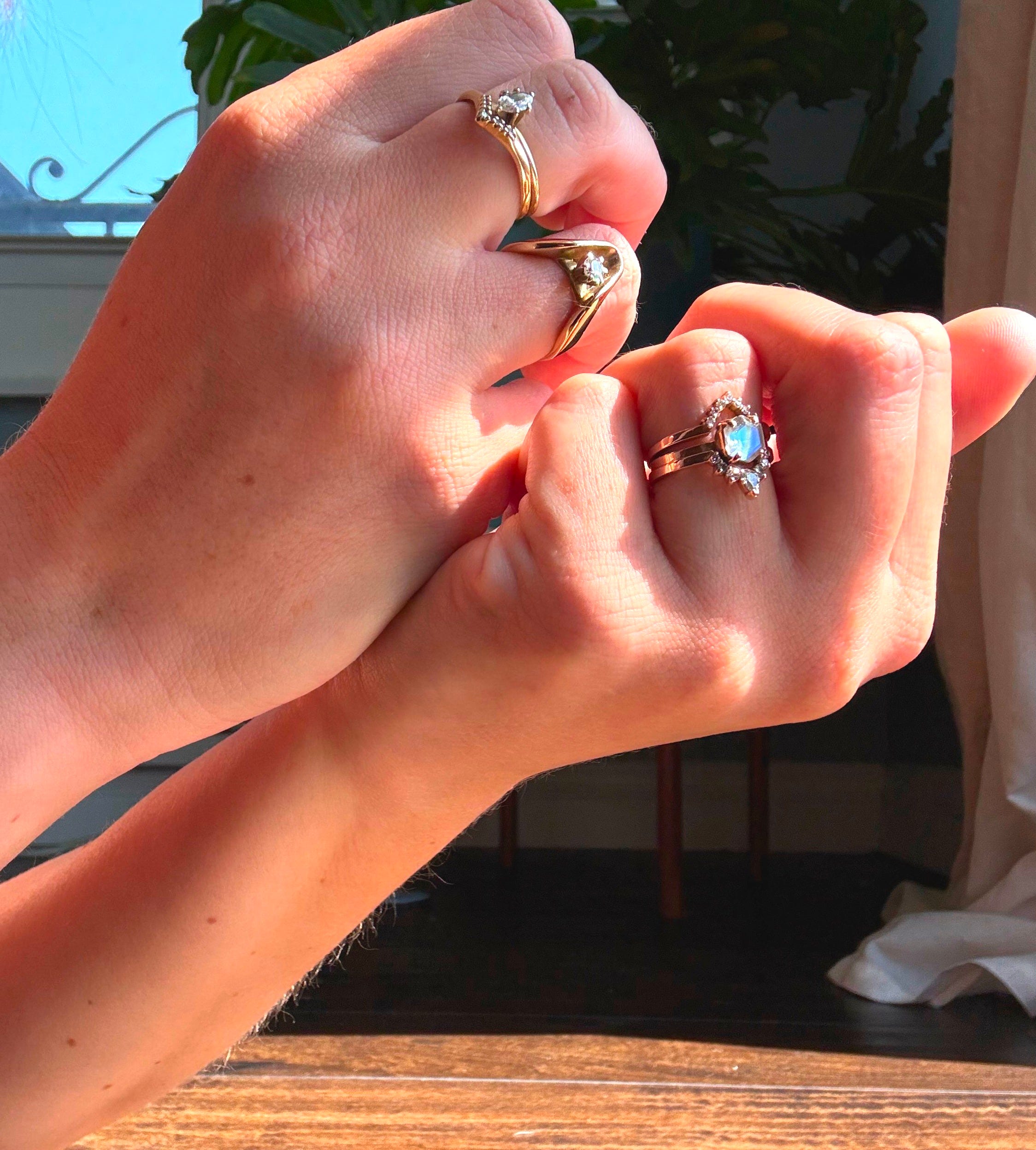
I wore my mother’s engagement ring on my finger until Hans bought me mine. When I got my ring, a hexagonal moonstone, I moved my mother’s ring to my right hand. My parents, still married despite it all, had somehow found a way, in their 60s, to spend loving time together, to talk gently to one another. They crowded into the frame on Facetime to congratulate us, their faces pressed together.
My grandmother wore a unique ring on her right-hand pinky finger. She designed the wave-like structure of the ring herself, and would clack it against the table when she drank her coffee. The last time I saw her, her dying body in a hospice bed in her living room, she bequeathed the ring to me. It was too large to fit comfortably on my pinky and too snug for my ring finger; for years I’ve let it sit in my drawer, waiting to get it resized.
I prioritized the ring this year for my birthday. Now it sits on my right-hand ring finger and my mother’s engagement ring sits on my middle. My moonstone on my left hand is now framed by two small wedding bands, the shape making a sunburst. The shape reminds me of how I felt that day when Hans proposed— alive, afloat, ablaze with love and possibility.
All three rings are golden. As if the silver never was.
Writing news: We have a cover for issue 22.1 of the Cincinnati Review! My award winning essay (which is also the title essay of my memoir) is in this issue.
This was so beautifully shared. You always write your life with such unflinching strength, the images you choose to include are continuously lucid no matter how dark. I’m just in awe of your light and feel too lucky to know your radiance. I read this and thought, look at what lasts. Your aureate words, your resplendent heart. Love love love love you.
heartbreaking & beautiful. the book in the rain destroyed me. you have been resilient for so long <3